
Afghanistan on Tuesday said it has received reports of reclusive Taliban leader Mullah Mohammad Omar being killed, but they have not been confirmed.
Omar runs a shadow government, complete with military, religious and cultural councils, and has appointed officials and commanders to virtually every Afghan province and district, just as he did when he ruled Afghanistan, the Taliban claim, the New York Times reported on Monday.
Taliban's supreme commander Mullah Mohammad Omar, now in hiding, has put pressure on his groups in Afghanistan and Pakistan to form a new grouping which has pledged to stop targetting Pakistani security forces and instead focus attention on US-led troops in Afghanistan.
Following the recent killing of Al Qaeda chief Osama bin Laden in an American military raid, the Obama administration has adopted a new strategy towards the chief of the Afghan Taliban Mullah Mohammad Omar, which is aimed at persuading the fugitive extremist leader to agree to a negotiated settlement of the decade-long conflict in Afghanistan, writes eminent Pakistani journalist Amir Mir.

Taliban chief Mullah Omar is dead, the Afghan government announced tonight, "confirming" reports about the one-eyed extremist leader who ruled the country with an iron fist between 1996 and 2001.
The Pakistan army has admitted that it is in contact with Afghan Taliban leaders, including Mullah Mohammad Omar, and can bring them to the negotiating table with the US if its concerns with India are addressed.
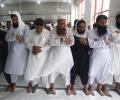
'The Mansoor Taliban is really an extension of the Haqqani Network which in turn is an instrument of the ISI. With Ashraf Ghani ready to dance to Pakistani tunes and with the Haqqani Network becoming part of the Afghan government, Pakistan is all set to see the fruition of its strategic policy,' says Sushant Sareen.

Afghanistan President Hamid Karzai has offered an olive branch to Taliban chief Mullah Omar, assuring him security if the latter gave up fighting and came forward for talks.
"Foreign troops should at once leave Afghanistan, and then the institutions they created should be dismantled. Unless this happens, war will heat up further. It will not recede," the one-eyed Omar said.
The offer of peace talks came at a time when the Pakistani military operations in the Federally Administered Tribal Areas on the Pak-Afghan border had had little impact on the operational capabilities of the Tehrik-e-Taliban. Amir Mir reports.

An audio message has been released in Pushto, circulated by Taliban commanders, where Akhundzada said, "Taliban will never bow their heads and will not agree to peace talks," reports Dawn.
These questions will need careful examination before one can come to a definitive conclusion on the implications of this message. But so many unanswered questions should not make us underestimate the importance of strengthened security in response to it.

Abdul Ghani Baradar, the Taliban leader freed from a Pakistani jail on the request of the US less than three years ago, has emerged as an "undisputed victor" of the 20-year war in Afghanistan, according to a British media report.
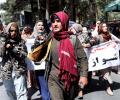
Mullah Muhammad Hassan Akhund is appointed as Prime Minister with two deputies Mullah Abdul Ghani Baradar and Molavi Abdul Salam Hanafi.

A militant commander said five people were killed in the firefight and several were injured "including Mullah Mansoor."

Pakistan, which has propped up the new Taliban leadership, would be keen to use its influence over the group to neutralise India's presence in the region.

The Taliban had promised an 'inclusive' government that represents Afghanistan's complex ethnic makeup, but there is no Hazara member in the cabinet.
There have been conflicting reports about whether Taliban's supreme council was consulted or not on the election

The United States respects Pakistan's sovereignty but will carry out strikes to eliminate terrorists who are targeting its forces, the Obama Administration said on Monday as Islamabad expressed concern over the drone strike by American forces on its territory to kill Taliban chief Mullah Akhtar Mansour.

Specially designated global terrorist Sirajuddin Haqqani, who carries a reward of $10 million US bounty on his head, is the acting interior minister while his uncle -- Khalil Haqqani -- has been named as acting minister for refugees.
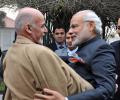
'Foreign ministry sources in Delhi discount the official version of the story, in which Modi made an impromptu request to stop over at Lahore, during the course of a birthday telephone call to Nawaz Sharif. In fact, this stopover had been carefully considered in Delhi, as a way to galvanise the peace process further.'
Lashkar-e-Tayiba founder Hafiz Mohammad Saeed has became one of only four terrorist leaders for whom the United States has offered a bounty of $10 million, joining the likes of Afghan Taliban chief Mullah Omar.
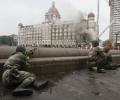
Through its early days to the 1980s, Pakistan sought to expand its sphere of Islamic influence through Afghanistan to Central Asia and got Pakistani citizens recruited in the Afghan government institutions in the 1990s when the Taliban were power. Now, it is looking eastward through India to Bangladesh and Myanmar to establish an imaginary caliphate.

'The ISI has given a stunning display of its capacity to do with impunity what it likes within Kabul. Incensed over the triumphalism of the hardliners in Kabul, the ISI has hit out; it is a typical ISI reflex action that Indians are familiar with,' says Ambassador M K Bhadrakumar.

Karzai has steadfastly opposed direct talks between the US and the Taliban, wanting Afghan ownership of the "reconciliation process", as the reintegration of the Taliban into the mainstream is referred to.

Pakistan's military can go to any length to inflict harm on India, so don't write off the possibility of an ISI-IS alliance, says Rajeev Sharma.

India is apprehensive about the Taliban's return as it would mean loss of access to Baluch rebels and help to the restive tribals of Waziristan. This would be a setback to the Indian strategy of returning the compliments of death by a thousand cuts to Pakistan, notes Colonel Anil A Athale (retd).

The Afghan deputy foreign minister explains how his nation's President became disillusioned with Pakistan. Ajai Shukla listens in.
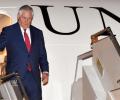
Pakistan Prime Minister Shahid Khaqan Abbasi assured the Secretary of State that his country is committed to the war against terrorism.
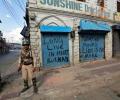
Separatists and their wide network must be neutralized for peace in the Valley

Rediff.com reproduces the translation of the remarks made by President Ashraf Ghani at a press conference.
